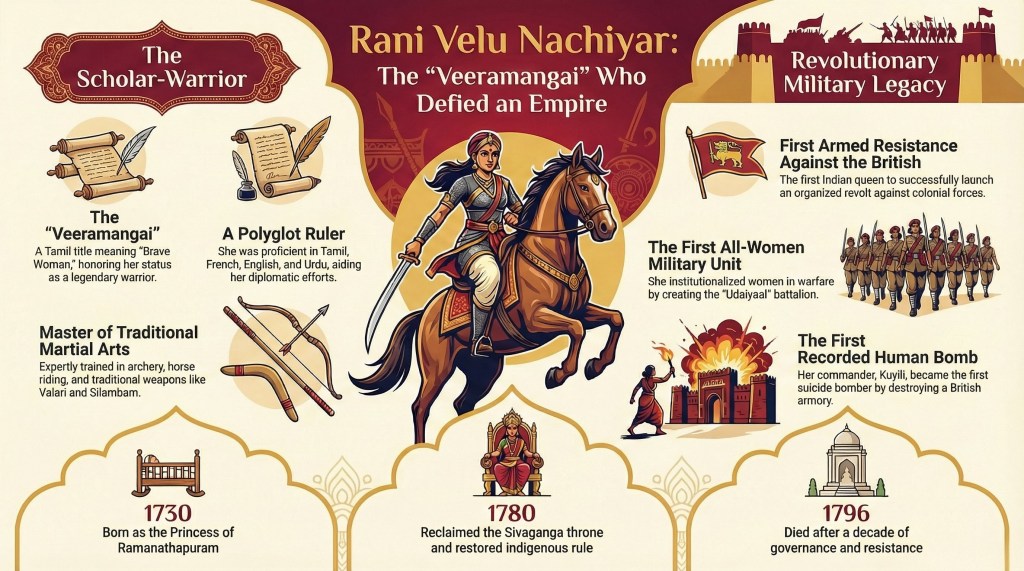
Indian resistance to colonial rule did not begin in 1857. Nearly eight decades earlier, Rani Velu Nachiyar, the ruler of Sivaganga in present-day Tamil Nadu, launched a successful armed resistance against the British East India Company. Revered in Tamil history as Veeramangai (the Brave Woman), she stands as India’s first female ruler to defeat the British through organized warfare and diplomacy.
A Pioneer of Pre-1857 Resistance
In 1772, her husband—King Muthuvaduganathaperiya Udaiyathevar—was killed in a joint attack by the British and the Nawab of Arcot. Forced into exile, Velu Nachiyar refused submission. After eight years of preparation, she recaptured Sivaganga in 1780, establishing indigenous rule at a time when the Company was still consolidating power in South India.
This makes her resistance one of the earliest successful anti-colonial uprisings in Indian history.
Knowledge as Strategy
Velu Nachiyar was a polyglot, fluent in Tamil, English, French, and Urdu. Her linguistic ability was not ornamental—it was strategic.
By communicating directly with Hyder Ali of Mysore in Urdu, she secured military assistance of 5,000 infantry and 5,000 cavalry, transforming exile into a counter-offensive.
Her diplomacy demonstrates that early resistance combined intellect with arms.
Military Innovation and Women in Warfare
Velu Nachiyar institutionalized women’s participation in combat through the Udaiyaal, one of India’s earliest all-women military units.
During the 1780 campaign, her commander Kuyili executed a decisive act of sacrifice by destroying the British ammunition depot inside Sivaganga Fort—the first recorded instance of a human bomb in Indian resistance history. This action broke British defenses and ensured victory.
Alliances and Inclusive Governance
Her resistance rested on strategic alliances, not isolation:
- Protection by Palayakaarar Gopala Nayakar
- Military support from Hyder Ali and later Tipu Sultan
She also pursued inclusive governance, commissioning both a mosque and a church, reflecting pragmatic pluralism rather than symbolic secularism.
Administrative Legacy: The Marudhu Brothers
After reclaiming her throne, Velu Nachiyar entrusted administration to Vellai and Chinna Marudhu, who later became leaders of the South Indian Rebellion (1799–1801).
Their Jamboo Deweepa Proclamation (1801)—calling for unity across religions against British rule—echoed the Queen’s inclusive vision.
Conclusion
Rani Velu Nachiyar proved that colonial power could be defeated through preparation, alliances, and indigenous military innovation. Her life challenges the North-centric and post-1857 framing of India’s freedom struggle and restores South India to its rightful place in early resistance history.
Prelims Fact Sheet
- Rani Velu Nachiyar was the first Indian queen to successfully wage an organized armed struggle against the British East India Company.
- Her resistance predated the Revolt of 1857 by nearly 80 years.
- 1780: Recapture of Sivaganga from the British
- Formed Udaiyaal → one of India’s earliest all-women military units
- Kuyili: Commander under Velu Nachiyar who Executed the first recorded “human bomb” attack in Indian anti-colonial history
- Allied with Hyder Ali (later Tipu Sultan)
- Language advantage: Used Urdu for direct diplomacy (bypassed interpreters)
- Followed inclusive governance, Built a mosque and a church → early example of secular administration
- Marudhu Brothers Led later phase of resistance in Tamil region, Issued Jamboo Deweepa Proclamation (1801)

 CIRCULAR LEARNINGS
We welcome your feedback