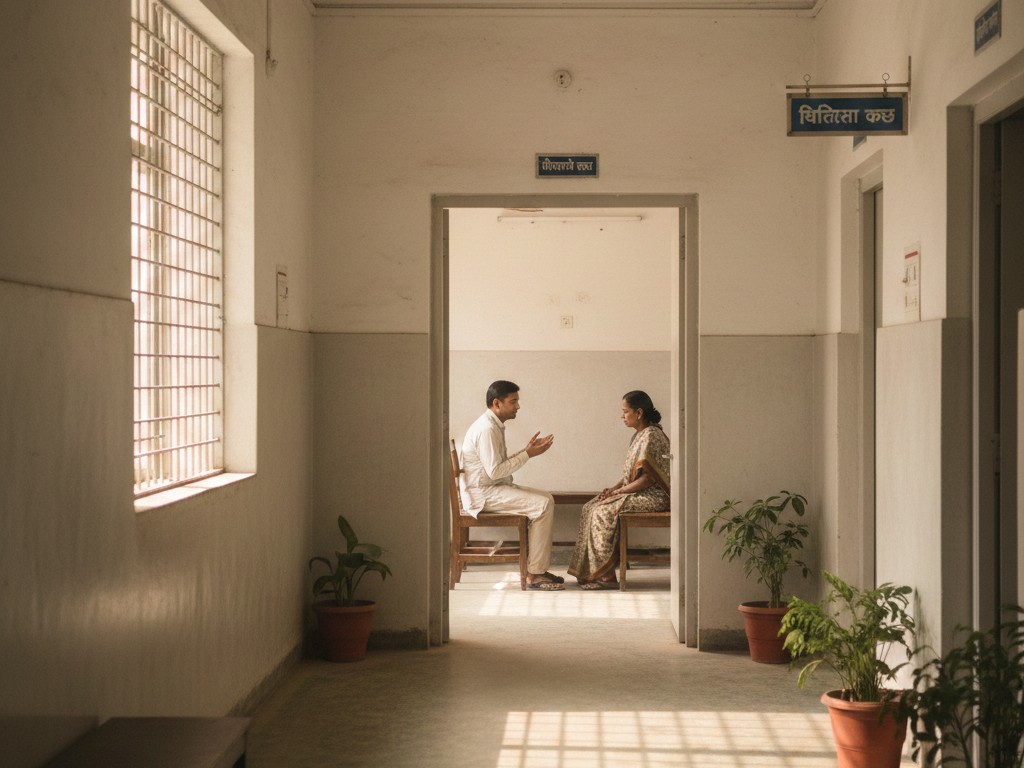
India’s mental health challenge has moved from the margins to the policy mainstream. Recent government documents—including the Economic Survey and Union Budget—acknowledge rising cases of depression, anxiety, and addiction, especially among children and adolescents.
India’s Mental Health Burden
- Mental health disorders account for nearly one-third of the global disease burden linked to depression and anxiety.
- WHO estimates 1 in 8 people globally live with a mental health condition.
- India faces a severe treatment gap due to shortage of professionals and uneven access across regions.
Structural constraint: India has far fewer psychiatrists per population than recommended international norms, creating chronic access issues—especially in rural and semi-urban areas.
What Has the Government Done So Far?
1. Infrastructure & Institutions
- Expansion of Mental Health Units in government hospitals.
- Upgrade of select institutions as Centres of Excellence to train specialists.
- Integration of mental health services into Ayushman Bharat – Health and Wellness Centres (HWCs) for primary-level access.
2. National Mental Health Programmes
- National Mental Health Programme (NMHP) strengthened to expand district-level coverage.
- Tele-MANAS (14416 / 1-800-891-4416) launched as a 24×7 mental health helpline with nationwide reach.
3. Human Resource Development
- Increase in postgraduate seats in psychiatry, psychology, and mental health nursing.
- Capacity building through short-term training and digital platforms.
Budgetary Allocation
- Mental health spending has increased in absolute terms over recent years.
- However, it remains below 2% of the total health budget, limiting scale and outreach.
- Experts note that allocation does not equal utilisation—funds often remain underused due to lack of trained staff and implementation capacity.
Key Gaps in India’s Mental Health Response
- Urban bias: Services concentrated in cities and tertiary hospitals.
- Workforce shortage: Inadequate psychiatrists, psychologists, and counsellors.
- Stigma: Social barriers discourage early reporting and treatment.
- Fragmented delivery: Weak coordination between health, education, and social sectors.
What Needs to Be Done Next?
Shift from Treatment to Prevention
- Embed mental health screening in schools, colleges, and workplaces.
- Focus on early intervention rather than crisis management.
Community-Based Care
- Strengthen primary healthcare and community health workers to deliver basic mental health support.
- Leverage telemedicine to bridge specialist shortages.
Whole-of-Government Approach
- Integrate mental well-being into education policy, labour policy, and social welfare.
- Address burnout, substance abuse, and digital addiction as public health issues.
Conclusion
India has taken important steps to recognise mental health as a public policy priority. Institutional expansion, helplines, and integration with primary healthcare mark genuine progress. Yet, the challenge lies in scaling access, strengthening human resources, and shifting the focus from episodic treatment to preventive care. Without sustained investment and community-level delivery, the gap between policy intent and lived reality will persist.