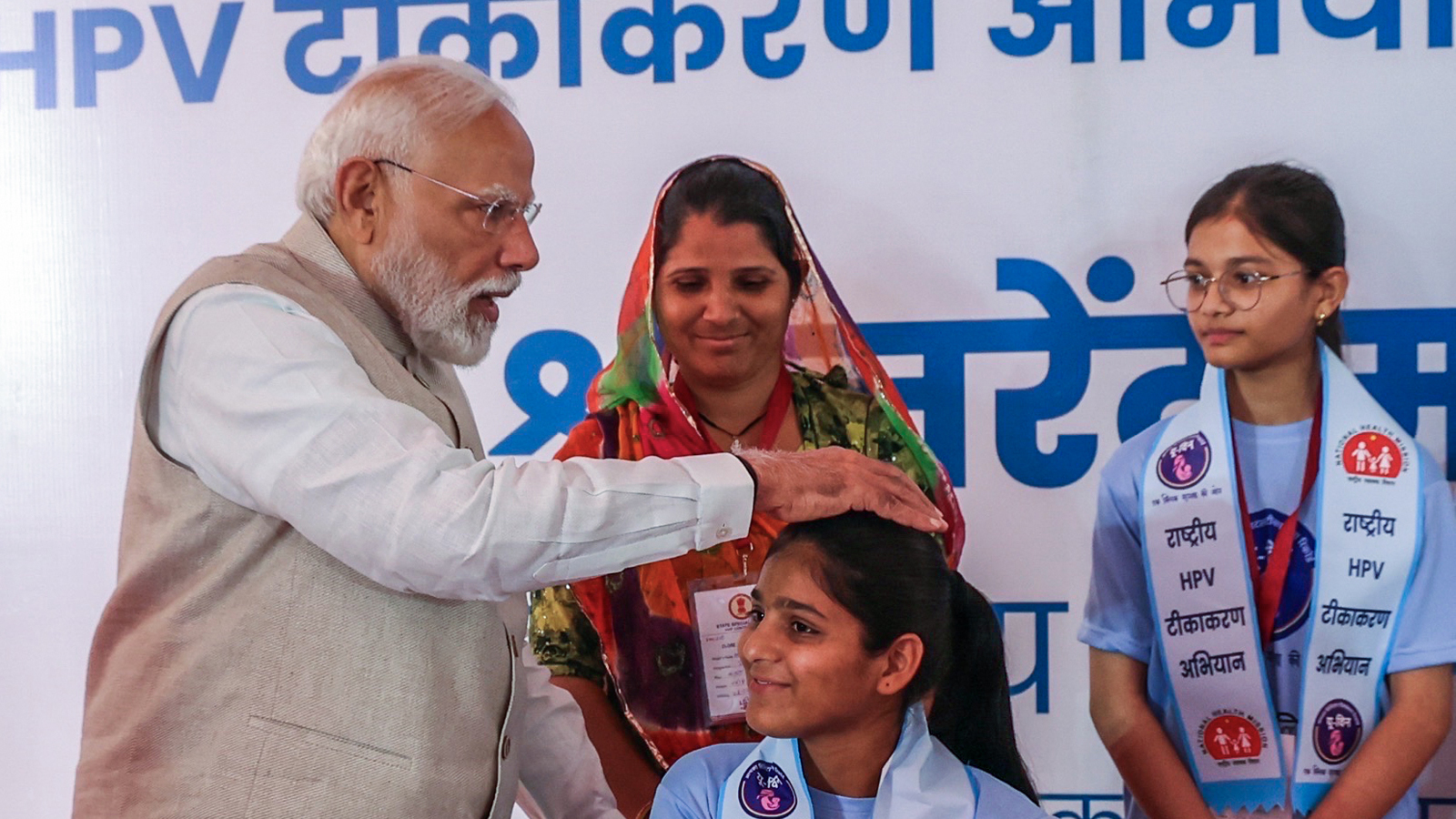
Cervical cancer remains one of the most preventable yet deadly diseases affecting Indian women. Caused primarily by high-risk strains of the Human Papillomavirus (HPV), it continues to claim thousands of lives each year despite the availability of an effective vaccine. India’s nationwide HPV vaccination drive marks a decisive shift from late-stage treatment to structured, population-level prevention within the public health system.
1. Understanding HPV and Cervical Cancer: The Scientific Base
Human Papillomavirus (HPV) is a common viral infection transmitted through intimate contact. While many infections resolve naturally, certain high-risk strains — especially HPV-16 and HPV-18 — persist and can cause cellular changes that eventually develop into cervical cancer.
Two features make cervical cancer distinct in public health terms:
- Clear Causative Agent – Unlike many cancers with multifactorial causes, cervical cancer is primarily linked to HPV infection.
- Available Preventive Vaccine – Vaccination before exposure can significantly reduce the risk of infection by high-risk strains.
This scientific clarity makes cervical cancer not merely treatable — but preventable.
2. The Epidemiological Burden in India
Public health policy must be burden-driven. The data establishes urgency:
- India accounts for nearly one-fourth of global cervical cancer deaths.
- Approximately 1.2 lakh new cases emerge annually.
- Nearly 80,000 women die each year due to cervical cancer.
- On average, one woman dies every eight minutes.
The disease disproportionately affects women in their productive years, magnifying socio-economic consequences:
- Household instability
- Intergenerational health and education setbacks
- Increased healthcare expenditure for families
Unlike diseases of lifestyle excess, cervical cancer largely affects women with limited access to screening and preventive care. That makes it a health equity issue, not just a medical condition.
3. The Policy Shift: From Curative to Preventive Oncology
Traditionally, India’s cancer response has centred on tertiary care — chemotherapy, radiotherapy, oncology centres. This is reactive governance.
The HPV vaccination drive marks a structural shift:
- From late-stage treatment to early-stage immunological prevention.
- From hospital-based response to community-level intervention.
- From episodic care to population-wide protection.
This is preventive oncology embedded into national immunisation architecture.
In policy terms, it represents long-term fiscal rationality — prevention is significantly cheaper than advanced cancer management.
4. Program Architecture: Design and Rollout
Key Facts for Prelims
Vaccine used: Gardasil (Quadrivalent)
→ Covers HPV 6, 11, 16, 18
Target group:
→ 14-year-old girls
Dose & delivery:
→ Single dose, free at government facilities
→ Given with parental consent, voluntary
Indigenous vaccine:
→ Cervavac (by Serum Institute of India)
→ Not yet part of national rollout
Private market option:
→ Gardasil 9 (nonavalent, wider coverage)
Target Cohort
The drive targets adolescent girls, primarily around age 14, ensuring immunisation before potential exposure.
Delivery Framework
- Government health facilities (PHCs, CHCs, District Hospitals, Medical Colleges).
- Free-of-cost vaccination model.
- Campaign-mode implementation initially, followed by integration into routine immunisation schedules.
Vaccine Strategy
- Protection against high-risk HPV strains responsible for the majority of cervical cancers.
- Adoption of a single-dose schedule, aligned with evolving global scientific consensus to enhance coverage and compliance.
Governance Tools
- Cold-chain monitoring systems.
- Adverse Event Following Immunisation (AEFI) protocols.
- Digital platforms for beneficiary tracking and stock management.
This reflects a Centre-led, State-executed cooperative federalism model — typical of large-scale immunisation drives in India.
5. Strategic Significance
A. Gender Justice and “Nari Shakti”
Women’s health is foundational to household stability. High maternal mortality or cancer-related deaths destabilise family structures and weaken long-term human capital formation.
The HPV drive therefore intersects with gender empowerment narratives — not symbolically, but structurally.
B. Health Equity
By providing free vaccination through public infrastructure:
- Income barriers are reduced.
- Rural and marginalised populations gain access.
- Preventive healthcare moves beyond urban-private dominance.
This advances substantive equality.
C. Economic Rationality
Cancer treatment involves high long-term expenditure — surgery, chemotherapy, hospitalisation.
Preventive vaccination reduces:
- Future fiscal burden on public health systems.
- Productivity losses due to premature mortality.
In macroeconomic terms, this strengthens human capital preservation.
D. Global Health Alignment
The drive aligns with the WHO’s strategy to eliminate cervical cancer as a public health problem through:
- 90% vaccination coverage
- 70% screening coverage
- 90% treatment access
India’s scale makes its participation critical to global elimination goals.
6. Implementation Challenges
Policy design is only half the battle. Execution determines impact.
1. Vaccine Hesitancy
Misinformation regarding fertility and side effects may affect uptake.
2. Regional Disparities
Remote geographies face cold-chain and last-mile delivery issues.
3. Screening Integration
Vaccination protects future cohorts; current adult populations still require screening.
4. Monitoring and Data Integrity
Digital tracking systems must remain accurate and interoperable across states.
Without sustained administrative discipline, coverage gaps can undermine herd protection.
7. The Way Forward
To consolidate gains, India must:
- Integrate HPV vaccination with school health programs for maximum reach.
- Expand cervical cancer screening programs (Pap smear and HPV testing) for older women.
- Invest in community-level awareness campaigns grounded in scientific clarity.
- Strengthen data systems to identify “zero-dose” populations.
Preventive success is measured over decades, not months.
8. Conclusion
India’s nationwide HPV vaccination drive represents more than a medical campaign — it institutionalises preventive oncology within the national development framework. By shifting focus from reactive treatment to anticipatory protection, the State acknowledges that sustainable public health is built not in oncology wards, but in early immunisation.
If executed with consistency and equity, this initiative has the potential to significantly reduce cervical cancer mortality in the coming decades, strengthening both women’s health and national human capital.