As countries attempt to tackle climate change, governments are increasingly adopting policies that price carbon emissions. However, these policies can create a new challenge known as “carbon leakage”—when industries move production to countries with weaker climate regulations.
To address this problem, the European Union (EU) introduced the Carbon Border Adjustment Mechanism (CBAM). The policy aims to ensure that imported goods face the same carbon costs as products manufactured within the EU.
Table of Contents
What is it?
The Carbon Border Adjustment Mechanism (CBAM) is a climate policy introduced by the European Union to place a carbon price on certain imported goods.
In simple terms:
- The EU already charges European industries for carbon emissions under the EU Emissions Trading System (ETS).
- CBAM ensures that imported products face a similar carbon cost.
- Importers must purchase CBAM certificates corresponding to the carbon emissions embedded in the goods.
This prevents foreign producers from gaining an unfair advantage by producing goods in countries with weaker environmental regulations.
Why Was CBAM Introduced?
The EU introduced CBAM for three major reasons.
1. Preventing Carbon Leakage
When domestic industries face strict climate regulations, they may shift production to countries with weaker standards.
This results in:
- No real reduction in global emissions
- Loss of industrial competitiveness
CBAM aims to discourage such relocation of industries.
2. Supporting Climate Goals
The EU aims to become carbon-neutral by 2050.
To achieve this goal, it is implementing policies such as:
- Carbon pricing
- Renewable energy expansion
- Industrial decarbonisation
CBAM ensures that climate policies remain effective even in a globalised economy.
3. Maintaining Fair Competition
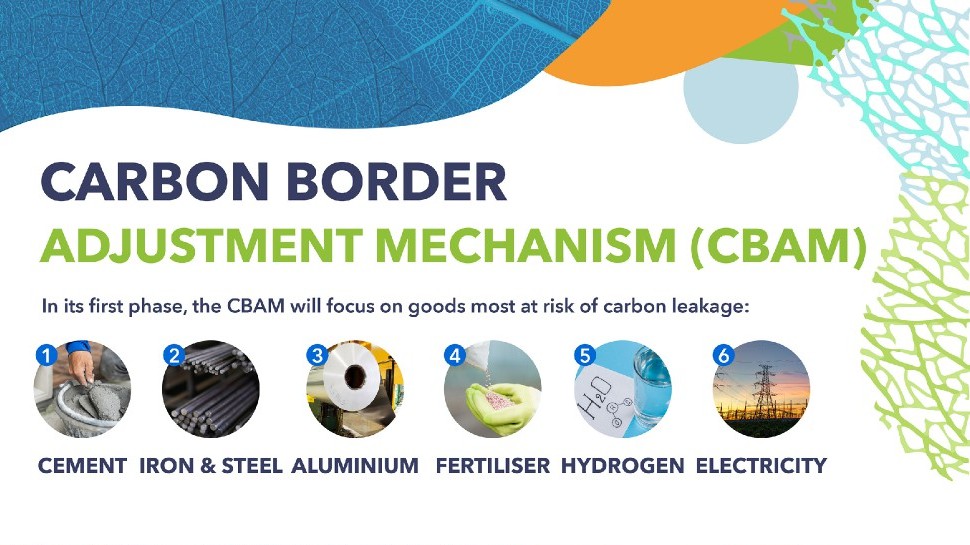
Initially, CBAM applies to carbon-intensive sectors.
These include: Iron and steel, Cement, Aluminium, Fertilisers, Electricity, Hydrogen etc.
These sectors were chosen because they: Produce large carbon emissions and face high risk of carbon leakage.
The EU may expand CBAM to other sectors in the future.
How CBAM Works

The CBAM system functions through a reporting and certification process.
Step 1: Reporting Emissions
Importers must report the embedded carbon emissions in the imported goods.
Step 2: Purchasing CBAM Certificates
Importers purchase CBAM certificates whose price is linked to the EU carbon price under the EU ETS.
Step 3: Adjustment for Carbon Price Paid Abroad
If a producer has already paid a carbon price in the exporting country, the EU deducts that amount from the CBAM cost.
This avoids double carbon taxation.
Implementation Timeline
The EU is implementing CBAM in phases.
Transitional Phase (2023–2025)
- Importers must report emissions
- No financial payments required yet
Full Implementation (From 2026)
- Importers must buy CBAM certificates
- Carbon costs will be fully applied to imports
Concerns of Developing Countries
Many developing countries, including India, have expressed concerns about CBAM.
1. Trade Protectionism
Some countries argue that CBAM is effectively a carbon tariff that could restrict exports.
2. Impact on Exports
Carbon-intensive industries in developing countries may face higher costs when exporting to the EU.
3. Climate Equity Issues
Developing countries argue that:
- Developed countries historically emitted more carbon
- Climate policies should consider common but differentiated responsibilities (CBDR)
Implications for India
1. Impact on Export Industries
India exports several CBAM-covered products to the EU, including: Steel, Aluminium, Chemicals, Fertilisers.
These sectors may face higher export costs.
2. Push for Industrial Decarbonisation
CBAM may encourage Indian industries to:
- Improve energy efficiency
- Adopt cleaner technologies
- Invest in green hydrogen and renewable energy
3. Trade Negotiations
CBAM has become an important issue in India–EU trade negotiations, including discussions under the India–EU Free Trade Agreement (FTA).

Way Forward
Countries are exploring solutions to balance climate goals with trade fairness.
Possible approaches include:
- Global cooperation on carbon pricing
- Climate finance and technology transfer
- Recognition of developing countries’ climate challenges
- WTO-compatible climate policies
A cooperative approach will be essential to ensure that climate policies do not lead to new trade conflicts.
Conclusion
The Carbon Border Adjustment Mechanism (CBAM) represents a major shift in global climate governance and trade policy. By placing a carbon price on imports, the EU aims to prevent carbon leakage and strengthen its climate ambitions.
However, the policy also raises complex questions about trade fairness, development equity, and global climate cooperation.
For India and other developing countries, CBAM highlights the growing importance of low-carbon industrial transformation in the emerging global economy.