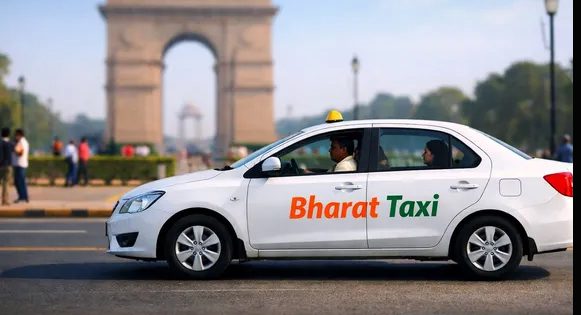
India’s gig economy has expanded rapidly, but its growth has exposed structural weaknesses—high platform commissions, opaque pricing algorithms, weak social security, and declining driver autonomy. Ride-hailing platforms increasingly extract value from local labour while centralising profits and decision-making.
Launched in February 2026 by Amit Shah, Bharat Taxi marks a policy-backed attempt to address these distortions. Built on cooperative principles and Digital Public Infrastructure (DPI), the platform represents a shift from platform capitalism to platform cooperativism.
1. From Gig Worker to Co-owner: Rewriting Labour Relations
At the heart of Bharat Taxi lies a structural departure from the aggregator model.
- Operated by Sahkar Taxi Cooperative Limited (STCL) under the Multi-State Cooperative Societies Act, 2002
- Drivers (“Sarathi”) are members and shareholders, not contractors
- Entry requires a nominal share purchase (₹500 for five shares)
- Drivers are entitled to dividends and voting rights
This ownership structure internalises value creation within the workforce, directly addressing the asymmetry between labour and platform capital that defines the gig economy.
2. Pricing Reform: From Algorithmic Surge to Predictability
Private aggregators rely on dynamic pricing and high commissions (often 30–40%), creating volatility for both drivers and passengers.
Bharat Taxi introduces:
- Zero commission in the initial phase
- Transition to a low flat subscription model (₹30/day for taxis; ₹18/day for autos)
- Surge-free pricing, replacing opaque algorithmic spikes with transparent fares
- Non-exclusive participation, allowing drivers to operate on other platforms simultaneously
This model shifts risk away from workers and restores income predictability—an important concern for informal labour markets.
3. Digital Public Infrastructure as an Enabler
Bharat Taxi is not a standalone app but part of India’s DPI ecosystem, developed with support from Ministry of Electronics and Information Technology and the National e-Governance Division.
Key integrations include:
- DigiLocker & UMANG for identity and service access
- API Setu for secure interoperability
- Built-in safety features including live tracking and police integration
This demonstrates how DPI can be used not just for efficiency, but for inclusive market design in the informal sector.
4. Social Security: Formal Protection for Informal Workers
A critical weakness of gig platforms is the absence of welfare mechanisms. Bharat Taxi embeds social protection directly into its operational framework.
Driver benefits include:
- Accident insurance cover of ₹5 lakh
- Family health insurance of ₹5 lakh
- Retirement-linked savings mechanisms
- Dedicated grievance and emergency support systems
This aligns with India’s broader push toward formalising informal labour without casualisation.
5. Gender Inclusion in Urban Mobility
Through initiatives such as Sarathi Didi and Bike Didi, the platform actively encourages women’s participation.
- Cooperative ownership reduces entry barriers
- Focus on safety, autonomy, and predictable earnings
This links mobility policy with women’s economic empowerment, a recurring governance priority.
6. Scale, Reach, and Early Challenges
The pilot rollout in Delhi-NCR and parts of Gujarat shows early traction:
- Over 3 lakh registered drivers
- More than 1 lakh users
- Around 10,000 daily rides
However, challenges remain:
- Operational bottlenecks at high-demand locations like airports
- Pricing mismatches with traditional prepaid systems
- Need for periodic fare revision to reflect fuel and insurance costs
These issues highlight the transition costs involved in moving from profit-driven platforms to cooperative digital models.

Conclusion
Bharat Taxi represents a significant experiment in applying cooperative principles to the digital economy. By combining worker ownership, transparent pricing, DPI-backed governance, and social security, it challenges the prevailing gig economy template.
Its success will depend on scalability, operational efficiency, and sustained driver trust. If institutional support and cooperative discipline hold, Bharat Taxi could offer a replicable model—showing that digital platforms need not centralise power, but can instead democratise it.
Leave a Reply