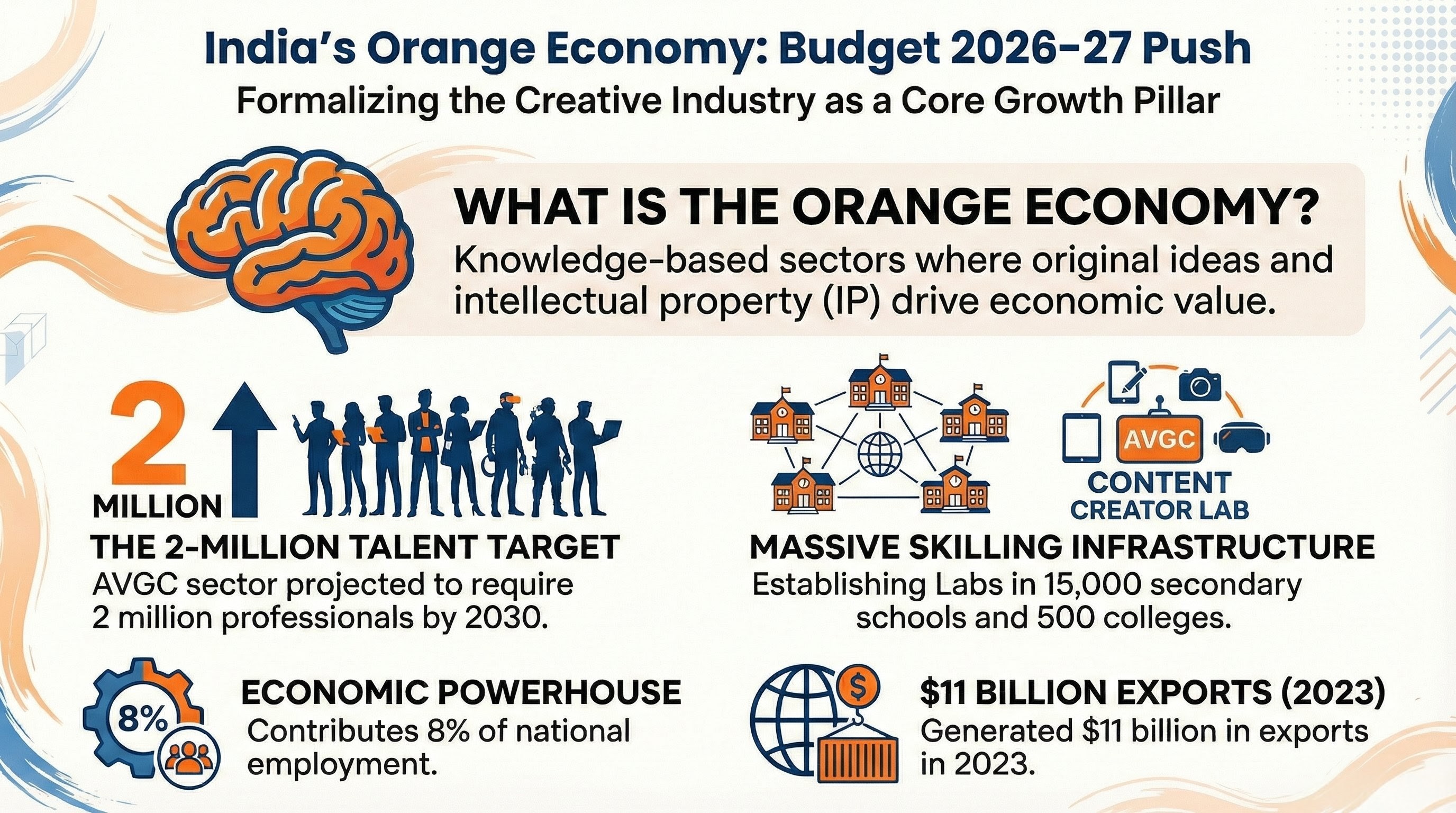
For decades, India’s growth strategy revolved around factories, farms, and physical infrastructure. Creative sectors—animation, gaming, design, media, heritage—were acknowledged culturally but ignored economically. Budget 2026–27 marks a clear departure from this thinking. By formally foregrounding the Orange Economy, the government is repositioning creativity as a productive economic force rather than a soft cultural accessory.
This pivot is not cosmetic. It reflects a deeper recalibration of how employment, skills, and value creation are expected to evolve in a digital, post-industrial economy.
Understanding the Orange Economy
The Orange Economy refers to economic activities driven by creativity, culture, and intellectual property. It includes both traditional cultural assets and modern creative industries.
At one end lie heritage sites, crafts, festivals, and cultural storytelling. At the other are high-growth commercial sectors such as animation, visual effects, gaming, comics (AVGC), media and entertainment, fashion, architecture, and digital advertising. Together, these sectors already account for a significant share of India’s value creation and employment, even without explicit policy focus until now.
Why the Shift Now
The core motivation behind this budgetary pivot is structural employment pressure. India’s demographic profile demands large-scale job creation, but traditional manufacturing alone cannot absorb a young, digital-native workforce at the required pace.
Creative industries offer a different growth logic. They are labour-intensive without being resource-intensive, scalable through skills rather than land or capital, and geographically flexible. This makes them suitable for employment generation beyond major industrial corridors and metropolitan centres.
Budget 2026 reflects an acknowledgement that future jobs will increasingly be idea-driven rather than asset-heavy.
From Elite Training to Mass Skilling
A defining feature of the budget is its approach to skilling. Instead of relying on a handful of elite institutions, the government has opted for scale-first intervention.
The proposal to establish AVGC content-creation labs across thousands of schools and colleges signals an attempt to mainstream creative-technical skills early in the education pipeline. The intent is to normalise careers in animation, gaming, and digital production before students are locked into narrow academic or vocational tracks.
This represents a shift from specialised excellence to ecosystem building, where access matters as much as talent.
Production Capability Over Platform Fame
Importantly, the budget does not conflate the Orange Economy with influencer culture or social media virality. The policy emphasis is on production depth, not digital popularity.
Skills such as real-time rendering, asset creation, sound engineering, and immersive technologies form the backbone of this approach. The objective is to create a workforce whose income depends on technical competence and project pipelines, rather than algorithmic visibility controlled by global platforms.
This distinction reflects an understanding that sustainable creative economies are built on production capacity, not attention cycles.
Creativity as Strategic Capital
The budget also treats creative industries as instruments of global presence. Countries that dominate cultural exports shape narratives, preferences, and perceptions far beyond their borders. By investing in storytelling, design, and media ecosystems, India is implicitly recognising creativity as a form of strategic capital.
Cultural destinations, global audio-visual platforms, and design institutions are no longer viewed merely as tourism or education projects, but as channels through which influence, branding, and economic value flow simultaneously.
Inclusion by Design
Unlike capital-heavy sectors, creative industries tend to be naturally inclusive. They exhibit higher participation by women, rely on flexible work arrangements, and allow regional and linguistic diversity to find markets without physical relocation.
Budgetary moves to integrate creative workers into formal social security systems indicate an effort to stabilise incomes in a sector traditionally marked by informality. This combination of flexibility and protection is critical if creative labour is to mature into a dependable employment base.
The IP Question
Perhaps the most consequential shift lies in the move from work-for-hire models to intellectual property ownership. India has long supplied skilled creative labour to global studios while retaining little control over the resulting value.
The current policy direction aims to change this by encouraging IP creation, improving access to finance for asset-light ventures, and recognising ideas as bankable economic assets. Ownership, rather than execution alone, is where long-term value resides.
Execution Risks
Despite its ambition, the Orange Economy pivot faces clear constraints. Teacher capacity remains uneven, access to credit for creative enterprises is limited, and regulatory frameworks have yet to fully adapt to asset-light, IP-driven business models. Without addressing these gaps, scale may come at the cost of quality.
Conclusion
Budget 2026–27 reframes creativity as an economic input rather than a cultural afterthought. By linking skills, employment, social protection, and intellectual property, it attempts to align policy with the realities of a young, digital workforce.
The real transformation underway is not from industry to art, but from labour-based services to idea-based value creation. Whether this shift delivers durable growth will depend on execution—but the direction itself marks a clear break from the past.